
Spirulina, a type of microalga, is well-known for its high nutritional content and various bioactive compounds. In particular, polysaccharide extracts from Spirulina have garnered interest due to their biological properties and numerous health benefits.
Dr. Wanida Pan-utai from the Department of Applied Microbiology at the Institute of Food Research and Product Development, Kasetsart University, and her research team have optimized a protocol for extracting crude polysaccharides using water extraction. They have also characterized the biological properties of these polysaccharides.
Polysaccharide extracts from oven-dried biomass of Spirulina exhibited promising antioxidant properties, as determined through three different assays: the DPPH Assay, ABTS Assay, and FRAP Assay. Furthermore, the extract demonstrated a greater suppression of alpha-glucosidase activity compared to the original oven-dried biomass, making it a potential option for controlling blood glucose levels and a safer alternative with reduced chemical use.
The growth of probiotics from the polysaccharide powder was found to be higher than that from inulin, a commercial prebiotic known for stimulating the growth of beneficial bacteria.
The elemental compositions of the extract were analyzed using the synchrotron X-ray fluorescence (XRF) technique at Beamline 7.2W of the Synchrotron Light Research Institute (SLRI) in Thailand. Figure 1 presents the X-ray fluorescence spectrum of both the Spirulina biomass and the polysaccharide powder derived from it.

Figure 1 Synchrotron X-ray fluorescence spectra of Spirulina biomass and polysaccharide powder derived from Spirulina
Citation: Life. 15, 1213. DOI: 10.3390/life15081213.
Table 1 Weight percentages from X-ray fluorescence (XRF) analysis.
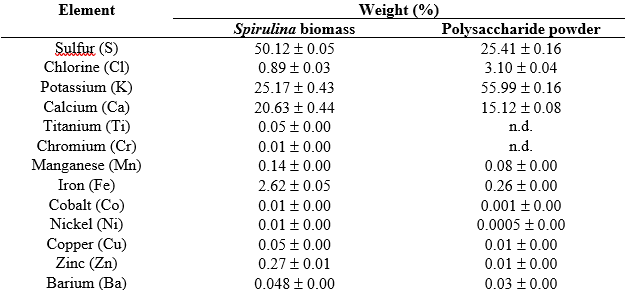
Values are presented as mean ± standard deviation (SD), where "n.d." denotes not detected.
Citation: Life. 15, 1213. DOI: 10.3390/life15081213.
The X-ray fluorescence (XRF) technique was used to simultaneously detect various elements in the samples, reporting their weight percentages. In the polysaccharide powder, the predominant inorganic mineral nutrients identified were sulfur (S), chlorine (Cl), potassium (K), and calcium (Ca), while iron (Fe) was found to be a minor element. Additionally, trace elements such as manganese (Mn), cobalt (Co), nickel (Ni), copper (Cu), zinc (Zn), and barium (Ba) were detected in the extractant.
This highlights the significant advantage of utilizing beamline capabilities to identify inorganic mineral nutrients, even when they are present in trace amounts. Furthermore, employing the synchrotron XRF technique in this research enables the simultaneous detection of a wide range of trace elements without the need for any chemical pretreatment, thereby reflecting their nutritive properties.
--------------------------------------
Article by Chomphunuch Songsiriritthigul (Beamline Scientist, SLRI)
References
Anwer, S. S. (2023). Direct analysis of algae for determination of major and minor elements using energy dispersive x-ray fluorescence (EDXRF). Kuwait Journal of Science, 50(4): 697–702. DOI: 10.1016/j.kjs.2023.04.012.
Pan-utai, W., Phomkaivon, N., Settachaimonkon, S., Pongponpai, P., Songsiriritthigul, C. (2025). Extraction, Characterization, Biological Properties, and X-ray Fluorescence Analysis of Functional Polysaccharides Derived from Limnospira platensis. Life. 15, 1213. DOI: 10.3390/life15081213.

111 SirinthonWitchothai Building, University Avenue, Muang District, Nakhon Ratchasima 30000, THAILAND
Tel.: +66 44 217 040 Fax: +66 44 217 047 Email: siampl@slri.or.th
Copyright © 2015 Synchrotron light research institute. All Rights Reserved.
|
|