
Research Highlight/News
Research Highlight/News
Research Highlights
Selected research performed at BL8 XAS/XFI, grouped by field.
Energy Storage
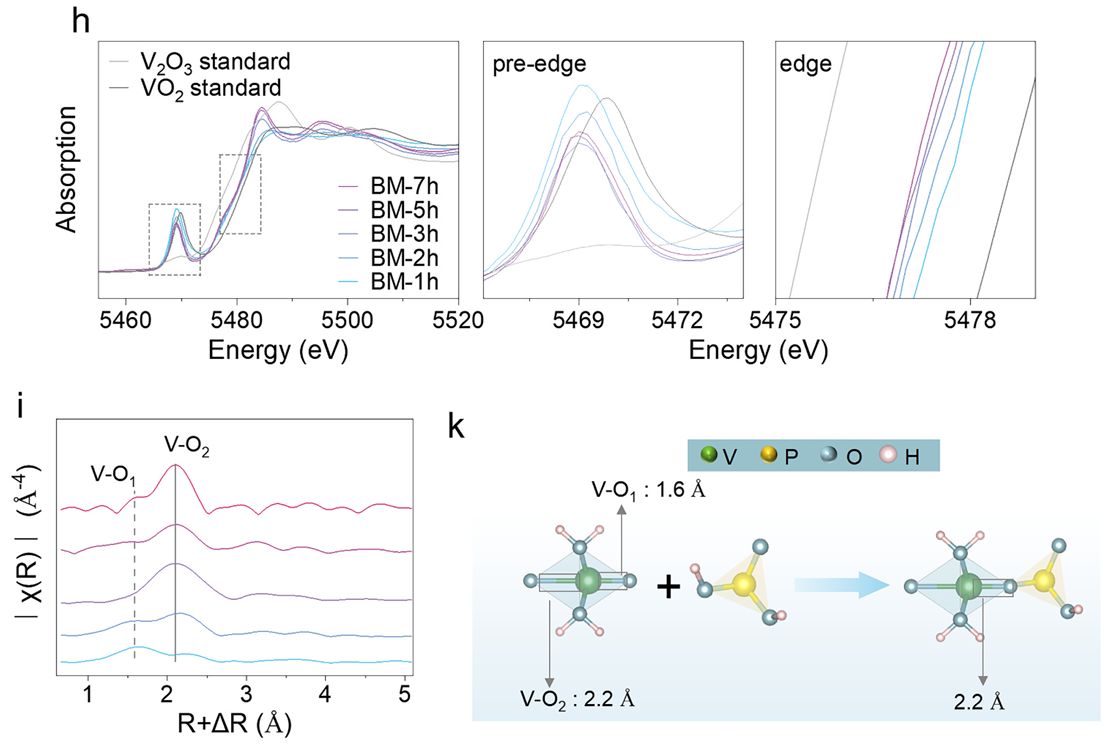
One-Step Maturation Pathway of Polyanion-Type Na3V2(PO4)3 Towards Scalable Production and High-Performance Na-Ion Pouch Cells
This work introduces a facile one-step maturation strategy to synthesize polyanion-type Na3V2(PO4)3 with optimized crystallinity and morphology, enabling scalable production and high-performance Na-ion pouch cells for next-generation energy storage.
Technical Highlights
- Synthesis: One-step thermal maturation process for Na3V2(PO4)3, eliminating complex multi-step procedures.
- XAS: V K-edge XANES and EXAFS confirm oxidation state (V3+) and local coordination environment stability during cycling. EXAFS analysis reveals robust V–O bonding and minimal structural distortion, ensuring long-term durability.
- Complementary techniques: XRD, SEM/TEM for morphology, and electrochemical impedance spectroscopy.
- Electrochemical performance: High-capacity retention and rate capability in Na-ion pouch cells; excellent cycling stability over extended cycles.
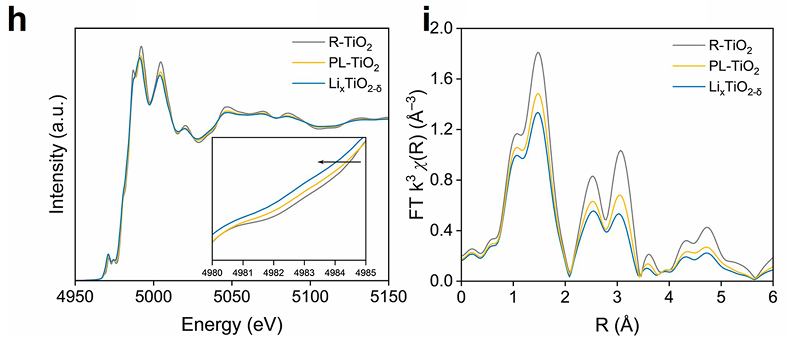
Fully Lithiated LixTiO2−δ Layer Coated Separator for Securing a Lithium-less Anode in an Ester-Based Electrolyte
This study introduces a scalable electrochemical prelithiation strategy to create a fully lithiated LixTiO2−δ layer on a polypropylene separator. The modified separator suppresses dendrite growth, stabilizes the SEI, and enables safe, high-energy-density lithium metal batteries under lean ester-based electrolyte conditions.
Technical Highlights
- Material design: TiO2 nanoparticles coated on PP separator, prelithiated to form LixTiO2−δ with oxygen vacancies and Ti3+ species.
- XAS: Ti K-edge XANES shows edge shift to lower energy, confirming reduction from Ti4+ to Ti3+ during lithiation. EXAFS reveals decreased Ti–O coordination number and weakened Ti–O–Ti interactions, indicating structural disorder and enhanced electron richness.
Catalysis
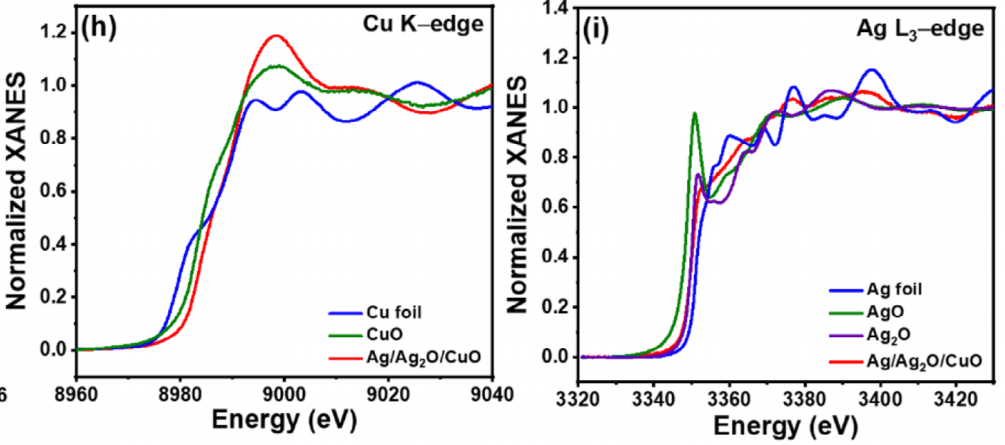
Harnessing Surface-Tuned Ag/Cu Interfaces in Ag/Ag2O/CuO for High-Efficiency Ammonia Synthesis and Co-Electricity Generation in Zn–Nitrate Batteries
This study introduces a hierarchical Ag/Ag2O/CuO composite synthesized by PLAL for efficient nitrate reduction to ammonia (NO3RR) and simultaneous electricity generation in Zn–nitrate batteries. The surface-tuned Ag/Cu interface significantly enhances electrocatalytic performance, achieving Faradaic efficiency >92% and enabling sustainable energy and environmental remediation.
Technical Highlights
- Synthesis: Pulsed Laser Ablation in Liquid (PLAL) for Ag/Ag2O/CuO composite.
- Characterization: XAS (XANES at Cu K-edge and Ag L3-edge); XPS, Raman, FTIR, HR-TEM.
- Performance: Faradaic efficiency 92.2% at −0.3 V vs RHE; NH4+ yield 6.4 mg·h−1·cm−2.
- Battery application: Zn–nitrate battery OCV 1.48 V; FE 93.5% at 8 mA·cm−2.
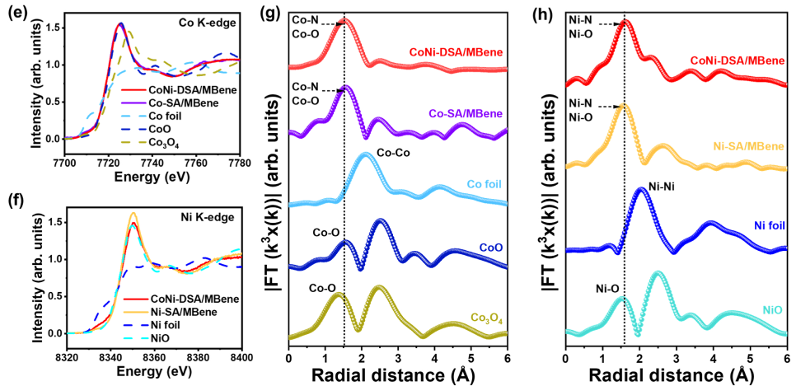
Paradigm for Swift Dual Single-Atom Stabilization on MBene using a CO2 Laser in Trifecta Energy with Ammonia Production
This study introduces a fast and efficient CO2 laser strategy to stabilize dual single atoms (Co/Ni) on MBene within 3 minutes, enabling superior nitrate reduction to ammonia (NO3RR) and co-electricity generation in Zn–nitrate batteries. It demonstrates a scalable approach for designing advanced single-atom catalysts for sustainable energy and environmental applications.
Technical Highlights
- Rapid laser-assisted synthesis: Continuous-wave CO2 laser (10.6 µm, 25 W) enables 3-minute stabilization of dual single atoms (Co and Ni) on MBene (MoAl1−xB) surface; functionalization with L-tryptophan ensures strong anchoring sites.
- XAS: Co and Ni K-edge XANES confirm oxidation states and coordination environment of single atoms. EXAFS shows absence of Co–Co or Ni–Ni scattering paths, validating isolated single-atom dispersion. Edge shifts indicate partial positive oxidation states, favorable for NO3RR catalysis.
- In situ Raman + DFT: Reveals electronic coupling between Co/Ni d-orbitals and nitrate intermediates, enhancing charge transfer.
Deciphering Indirect Nitrite Reduction to Ammonia in High-Entropy Electrocatalysts Using In Situ Raman and X-ray Absorption Spectroscopies
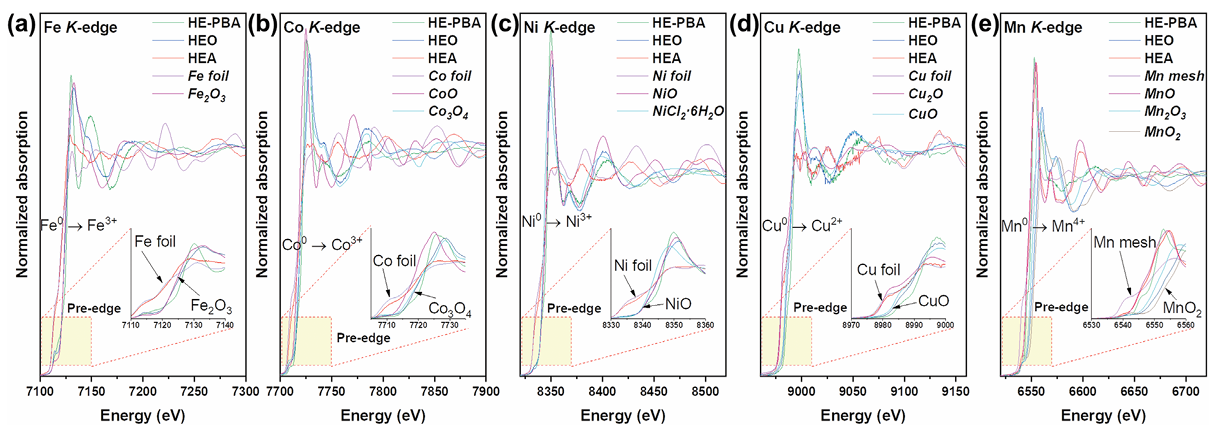
A facile calcination + PLIL route produces single-phase, conductive HEA (Fe–Co–Ni–Cu–Mn) that efficiently converts nitrite (NO2−) to ammonium (NH4+) with high Faradaic efficiency and durability. In situ Raman uncovers oxy(hydroxide)-mediated, proton-assisted indirect pathways, while XAS resolves oxidation states and local structures across HE-PBA → HEO → HEA.
Technical Highlights
- Synthesis & structure: Co-precipitated HE-PBA → HEO (spinel-like) at 350 °C → fcc-HEA after PLIL (532 nm, 180 mJ, 10 Hz, 10 ns); single-phase HEA confirmed by XRD/Raman/TEM/EDS.
- XAS (Fe, Co, Ni, Cu, Mn K-edges): XANES tracks element-specific oxidation state shifts (higher Fe/Co/Ni valence in HEO; metallic features in HEA). EXAFS shows metal–O shells in HEO and metal–metal bonds ≈2 Å in HEA.
- In situ Raman: Reveals formation of surface (oxy)hydroxides that generate excess H+ from water dissociation; H+ hydrogenates NO* intermediates to NH4+.
Catalytic Transfer Hydrogenation of Furfural to Furfuryl Alcohol and 2-Methylfuran over CuFe Catalysts: Ex Situ Observation of Simultaneous Structural Phase Transformation
Developed a H2-free process for furfural conversion using CuFe catalysts with simultaneous activation and reaction.
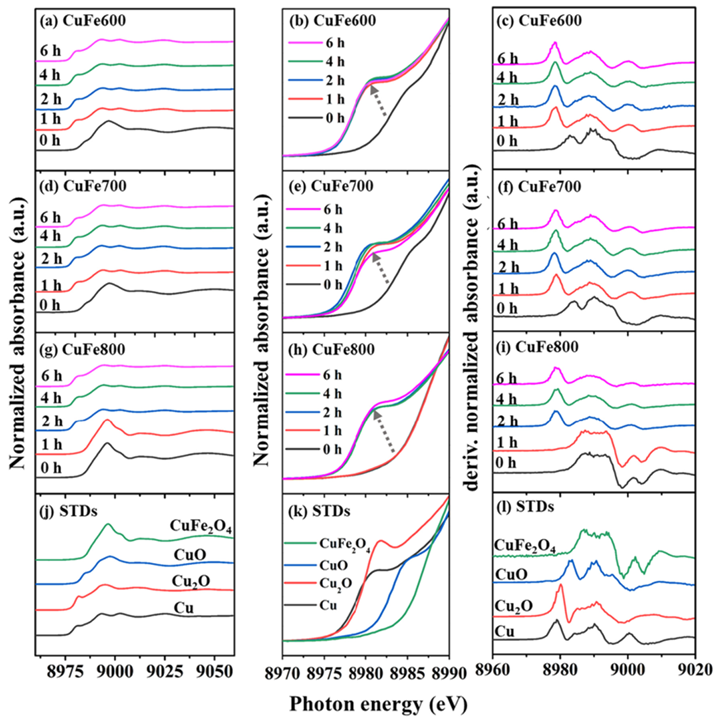
- Isopropanol acts as both hydrogen source and reducing agent, enabling in situ transformation of CuO/Fe2O3 → metallic Cu and Fe3O4.
- CuFe700 catalyst showed highest activity and better stability than CuFe600 and CuFe800.
- Magnetic property improvement allows easy catalyst recovery.
Technical Highlights
- XANES at BL8: Cu species CuO → metallic Cu (Cu0) within 1 – 2 h; Fe species Fe2O3 → Fe3O4 during CTH.
- XRD: Confirmed phase transformation after reaction.
- Detection: Metallic Cu and Fe3O4 are active species for CTH.
- Catalytic performance: CuFe700 furfural conversion ≈96%, FOL yield ≈89.6%, 2-MF yield ≈5.5% (at 200 °C, 2 h).
- Magnetization: Increased from 4 emu/g (calcined) to 38.5 emu/g (spent catalyst).
Materials Science
Synergistic Effects of Haematite/Hausmannite Anchored Graphene Hybrids in High-Energy Density Asymmetric Supercapacitors
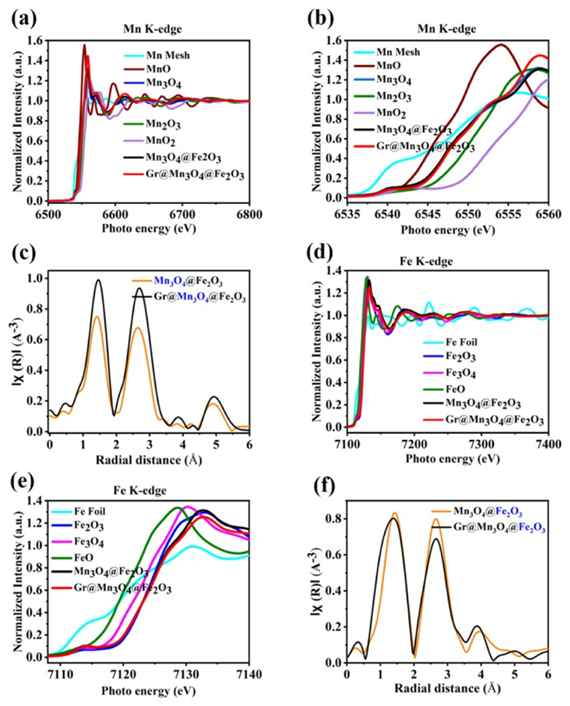
The study demonstrates a cost-effective fabrication route for graphene-anchored Mn3O4/Fe2O3 hybrids that deliver high specific capacitance and robust cycle stability in ASC devices. Synchrotron XAS verifies mixed Fe/Mn valence states underpinning the synergistic charge storage behavior.
Technical Highlights
- Material & architecture: Graphene-supported haematite (Fe2O3) and hausmannite (Mn3O4) ternary composite grown on Ni foam (Gr@Mn3O4@Fe2O3/NF).
- Synchrotron XAS: Fe/Mn XANES indicates a blend of Fe3+ and Mn2+ valence states in the composite; EXAFS supports the local coordination consistent with the hybrid structure.
Insight into the Molecular Interaction of Trace As(III) and As(V) onto the Hybrid Anion Exchanger Impregnated with Fe/Mn Nanoparticles (HA502P-Fe/Mn)
A novel hybrid anion exchanger impregnated with Fe/Mn nanoparticles (HA502P-Fe/Mn) effectively removes trace arsenic species from water through:
- Oxidation of As(III) to As(V) by MnO2.
- Adsorption of As(V) onto Fe/Mn oxide surfaces.
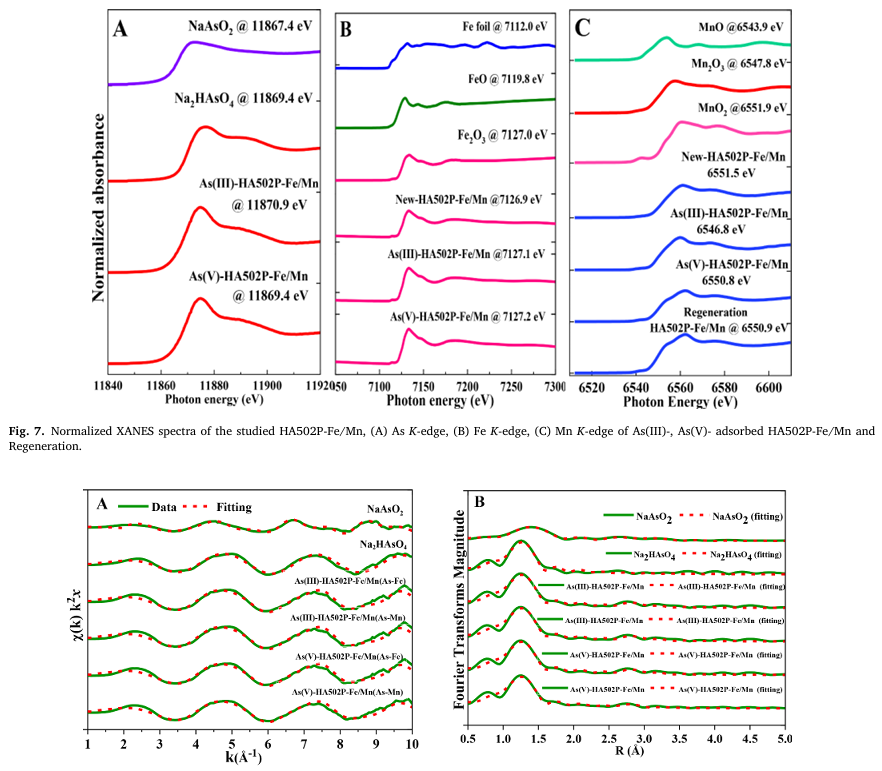
- Supported by XAS (XANES & EXAFS) and DFT modeling confirming inner-sphere complexation.
Technical Highlights
- XAS at BL8: XANES confirms oxidation of As(III) → As(V). EXAFS reveals inner-sphere complexes: As–Fe bidentate binuclear corner-sharing (2C), ~3.34 Å; As–Mn bidentate mononuclear edge-sharing (2E), ~2.94 Å.
- Adsorption capacity: 21,590 µg/g (As(III)), 18,930 µg/g (As(V)).
- Kinetics: Pseudo-second-order model (R² = 0.987).
- DFT: Confirms structural optimization and bond distances.
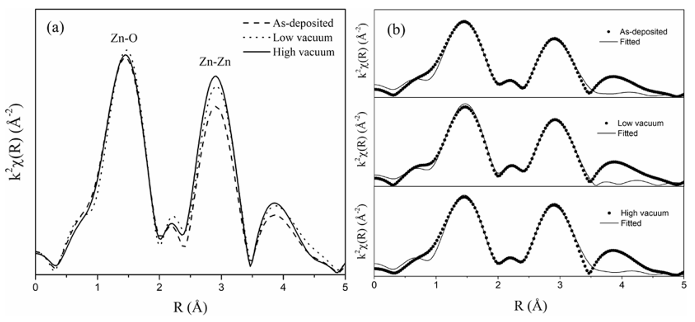
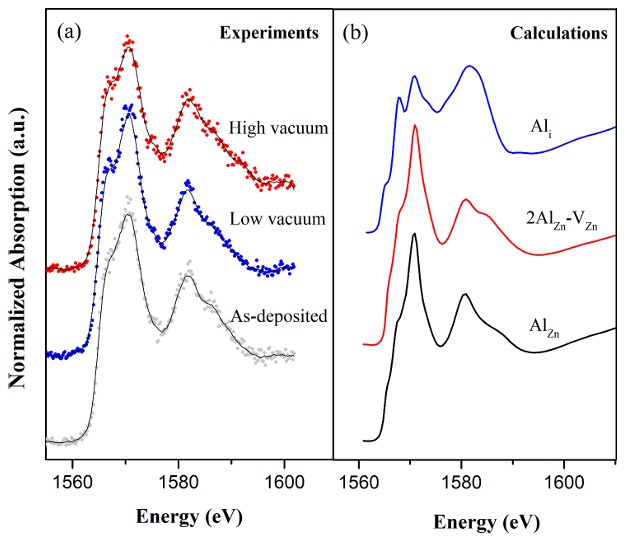
Correlation of Conductivity Enhancement and Al-Site Defects in Nanocolumnar ZnO Films under Vacuum Annealing by Experimental and Calculations
Vacuum annealing significantly enhances the electrical conductivity of Al-doped ZnO (AZO) nanocolumnar films by:
- Defect transformation: From complex defects (AlZn–VZn–Ali) in as-deposited films to AlZn–Ali complexes after annealing.
- Mechanism: Migration of Al interstitials (Ali) to Zn vacancies (VZn), reducing acceptor defects and increasing donor states.
- Result: Carrier concentration and mobility increase; resistivity drops by an order of magnitude.
Technical Highlights
- Fabrication: Pulsed DC magnetron sputtering with GLAD technique; annealing at 400 °C under low/high vacuum.
- Characterization: XPS for chemical states and defects; XAS (BL8, SLRI): Al K-edge XANES and Zn K-edge EXAFS for local structure; Hall effect for electrical properties.
- Computational: DFT + FEFF9 for defect formation energy and simulated XANES spectra.
Soil & Environmental Science
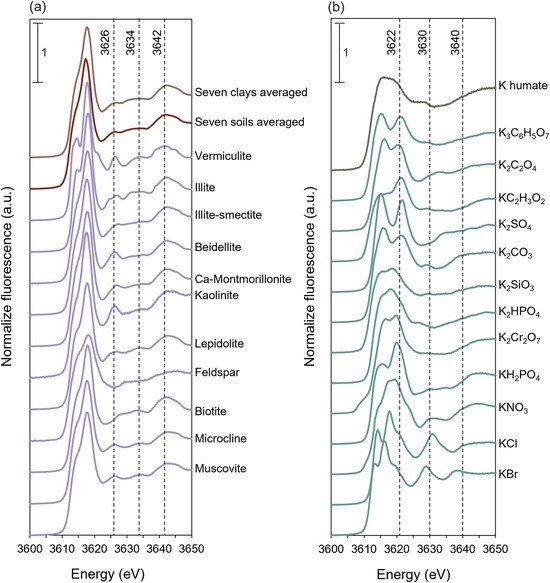
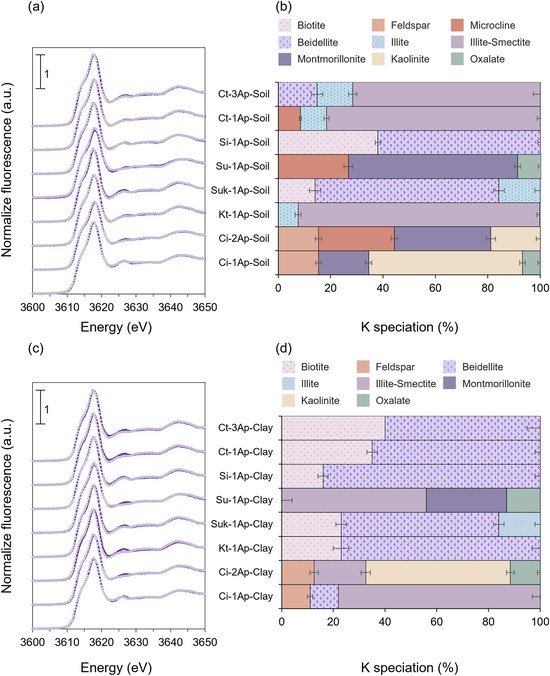
Dominance of 2:1 Clay Minerals in Soil Potassium across a Weathering Gradient: Insights from K K-edge XANES Speciation and Sequential Extraction
2:1 clay minerals are the primary hosts and buffers of soil K across tropical weathering gradients, particularly in less-weathered soils; kaolinite plays a minor role, while primary silicates remain detectable K reservoirs. Integrating element-specific K K-edge XANES with sequential extraction clarifies K speciation vs. extractability, crucial for soil health and fertilizer K management.
Fate of Silicon in Tropical Agricultural Soil Clays Using XANES Spectroscopy
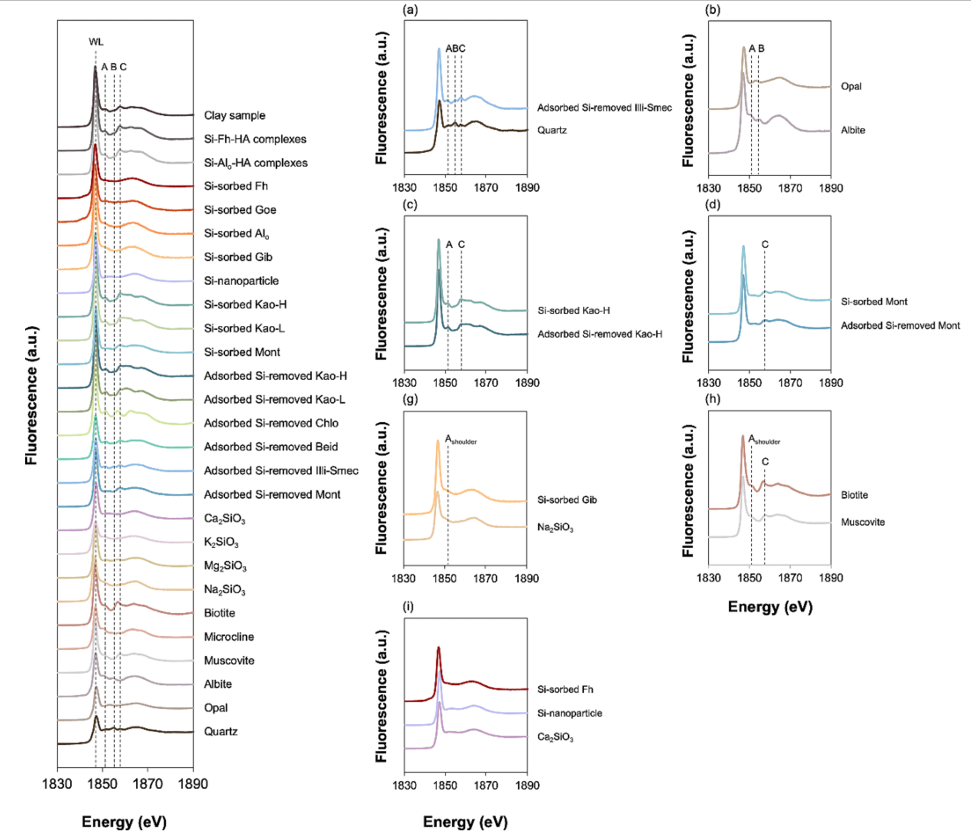
The study establishes a novel Si K-edge XANES reference library and applies linear combination fitting to clay-sized fractions of tropical soils, revealing that beidellite, montmorillonite, and kaolinite host substantial structural Si, while Si adsorbed to kaolinite and Fe oxyhydroxides (including ferrihydrite–NOM complexes) also contributes. It shows that extractable Si is extremely low relative to total Si and correlates positively with pH, organic matter, and clay content.
Technical Highlights
- Reference library: Built and classified 26 standards (primary silicates; structural Si in clays; Si-sorbed clay minerals; Si-sorbed Fe/Al oxides; Si–oxide–humic complexes; Si nanoparticles), differentiated via white-line energy (~1846.9 eV), white-line intensity, pre-edge, and post-edge features (A ≈1851 eV, B ≈1855 eV, C ≈1858 eV).
- Beamline & acquisition: SLRI BL8 (InSb(111) monochromator; 13-element SDD; fluorescence mode; Si K-edge 1789 – 2039 eV; Athena self-absorption correction; LCF without energy shift).
- LCF outcomes: Dominant structural Si phases: beidellite (avg ~53%), illite-smectite (avg ~40%), montmorillonite, kaolinite; frequent Si-sorbed montmorillonite (avg ~27%) and Si-sorbed high-defect kaolinite (avg ~34%).
- Pre-edge diagnostic: Pronounced pre-white-line for Si-sorbed Fe oxyhydroxides (goethite > ferrihydrite); absent for Si-sorbed Al oxyhydroxides and Si–Fh–HA.
Aluminum Speciation in Forest Soils and Forest Floor Density Fractions Using Synchrotron-Based XANES Spectroscopy
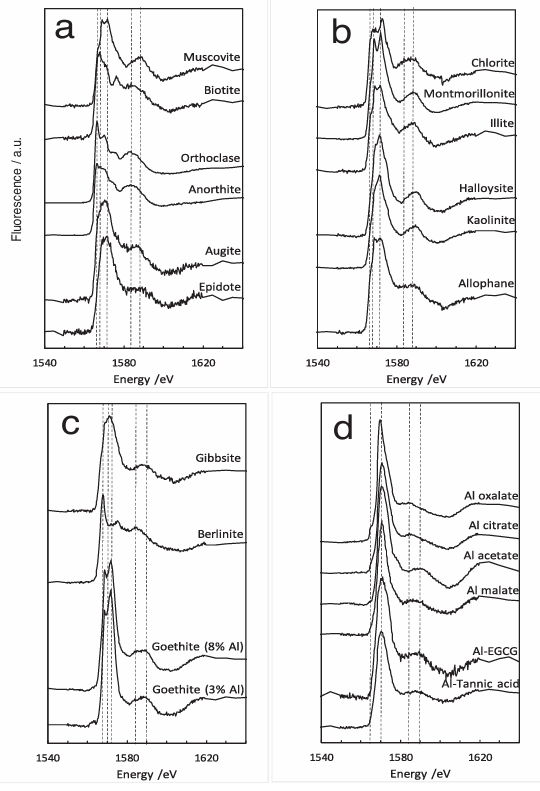
Synchrotron-based Al K-edge XANES spectroscopy enables direct, non-invasive semi-quantification of Al species in soils:
- Organically bound Al decreases with depth (O layers: 20 – 43%; B horizons: <12%).
- Mineral-bound Al (clay minerals, feldspars) dominates in most horizons.
- Density fractionation reveals spatial separation: SOM-rich fractions contain phenol-bound Al; mineral-rich fractions contain clay/feldspar-bound Al.
Technical Highlights
- Technique: Al K-edge XANES at BL8 (SLRI, Thailand); energy range 1460 – 1760 eV; fluorescence mode with 13-element detector.
- Analysis: Linear Combination Fitting (LCF) using 22 reference compounds.
- Findings: Organically bound Al mainly phenol-complexed in SOM-rich fractions; mineral-bound Al in clay minerals (2:1 > 1:1) and feldspars dominates in mineral-rich fractions; no gibbsite detected; allophane marginal (<5%).
- Complementary methods: XRD and wet-chemical extraction for validation.
Mobility and Lability of Phosphorus from Highly Concentrated Fertiliser Bands
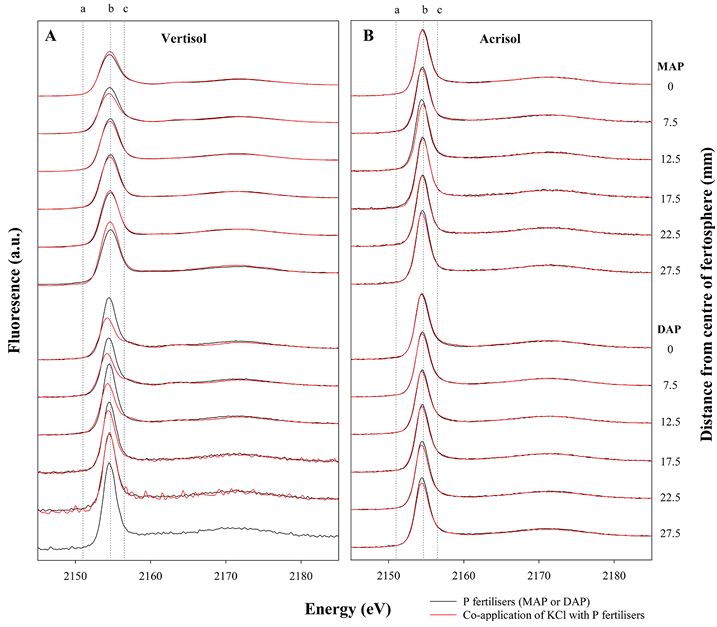
Highly concentrated fertilizer bands create localized zones of extreme P concentration, influencing mobility (how far P moves in soil), lability (availability for plant uptake), and chemical transformations of P species under these conditions.
Technical Highlights
- XAS: Used to identify P speciation, differentiating between orthophosphate, polyphosphate, and metal-P complexes.
- Soil incubation experiments with fertilizer bands.
- Analysis of diffusion gradients and reaction products.
- Findings: High P concentration promotes formation of less soluble species, reducing mobility over time.
Sulfur Speciation in Drained and Restored Minerotrophic Peatland Types of Northeastern Germany
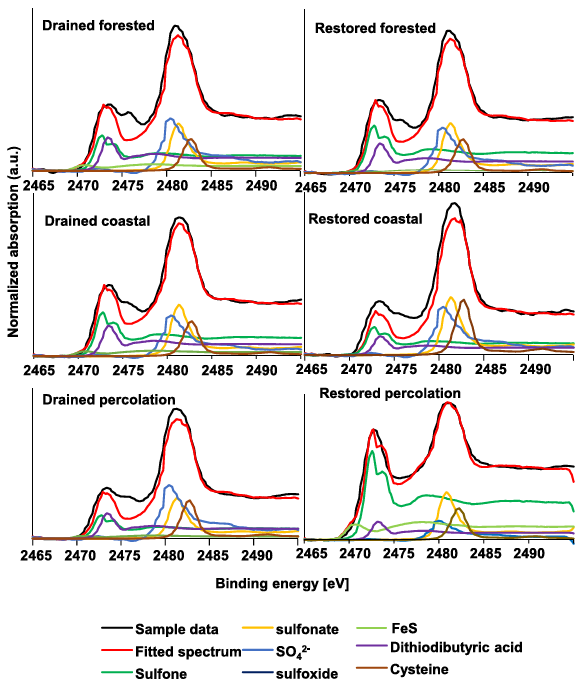
Long-term restoration of peatlands conserves total sulfur (St), reduces labile sulfur fractions, and enriches strongly reduced inorganic and organic sulfur species. This process mitigates sulfate-related freshwater pollution and supports anaerobic conditions favorable for carbon conservation.
Technical Highlights
- Techniques: Sequential sulfur fractionation (H2O, NaH2PO4, HCl extractions); S K-edge XANES at BL8, SLRI.
- XANES details: Energy range 2465 – 2495 eV; resolution ΔE/E ≈ 3 × 10⁻⁴; 13-channel Ge detector; ATHENA for processing and LCF.
- Findings: Organic S species dominate (76 – 97% of St). Groups identified: strongly reduced inorganic S (FeS); reduced organic S (DTBA, cysteine); intermediate oxidation states (sulfone, sulfonate); strongly oxidized inorganic S (sulfate).