
Experimental-station
experimental-station
Beamline 1.3W · Small and Wide Angle X-ray Scattering (SAXS/WAXS)
Experimental Station
Beamline Layout, Specification & Experimental Station
Beamline Layout and Specification

Figure 1: BL1.3W beamline layout, from source to Experimental Hutch — schematic, not to scale
BL1.3W Optical Layout
The light source is shared across three parallel beamlines — BL1.1W, BL1.2W, and BL1.3W — each divided into four sections: the Front End (FE), Optics Hutch 1 (OH1), Optics Hutch 2 (OH2), and the Experimental Hutch (EH).
Synchrotron light from the Multipole Wiggler passes through a Double Multilayer Monochromator (DMM) — a mirror coated with alternating layers of tungsten and boron carbide, 150 layers total at 2.5 nm per layer — which selects a working X-ray energy of 9 keV (1.38 Å), tunable across a range of 6–9 keV. The energy-selected beam then passes through a toroidal focusing mirror, which focuses the X-rays onto the sample position in the Experimental Hutch.
The beam travels the length of the beamline through a vacuum tube, ending at a beryllium (Be) window that separates the beamline vacuum from the experimental hutch. A beam shutter within the beamline opens and closes to control when X-rays reach the sample; SAXS/WAXS measurements are carried out by opening the shutter and triggering the detector at the same time, under computer control.
BL1.3W Specification
| Source Type | Multipole Wiggler (2.2 T) |
|---|---|
| Photon Energy | 6–9 keV (optimized at 9 keV) |
| Optics | Double Multilayer Monochromator (W/B₄C); Toroidal Focusing Mirror |
| Photon Flux | ~2 × 10⁹ phs/s |
| Beam Divergence | 0.4 mrad |
Experimental Station
X-ray Techniques Available at BL1.3W
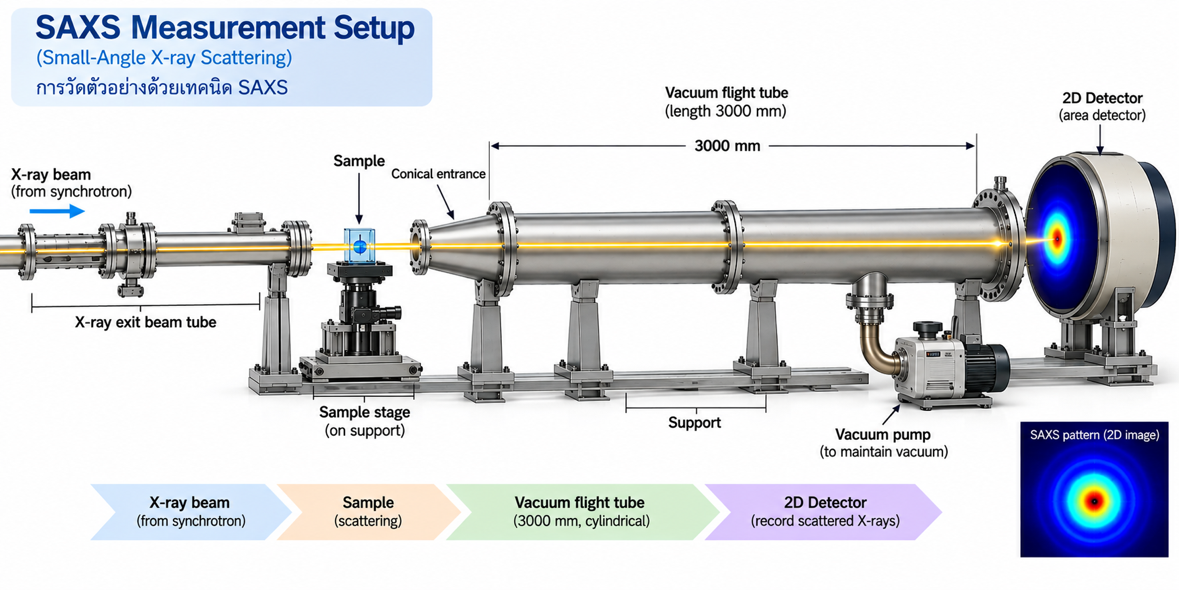
Small-Angle X-ray Scattering (SAXS)
Small-Angle X-ray Scattering (SAXS) is a powerful X-ray-based technique used to investigate the structure and morphology of materials at the nanoscale. SAXS measures the scattering of X-rays at very small angles as they interact with variations in electron density within a sample. The technique provides structural information in the nanometer range, typically from approximately 1 to 100 nm, depending on the experimental configuration. SAXS can be applied to a wide range of materials, including polymers, proteins, nanoparticles, composites, colloids, and biological materials.
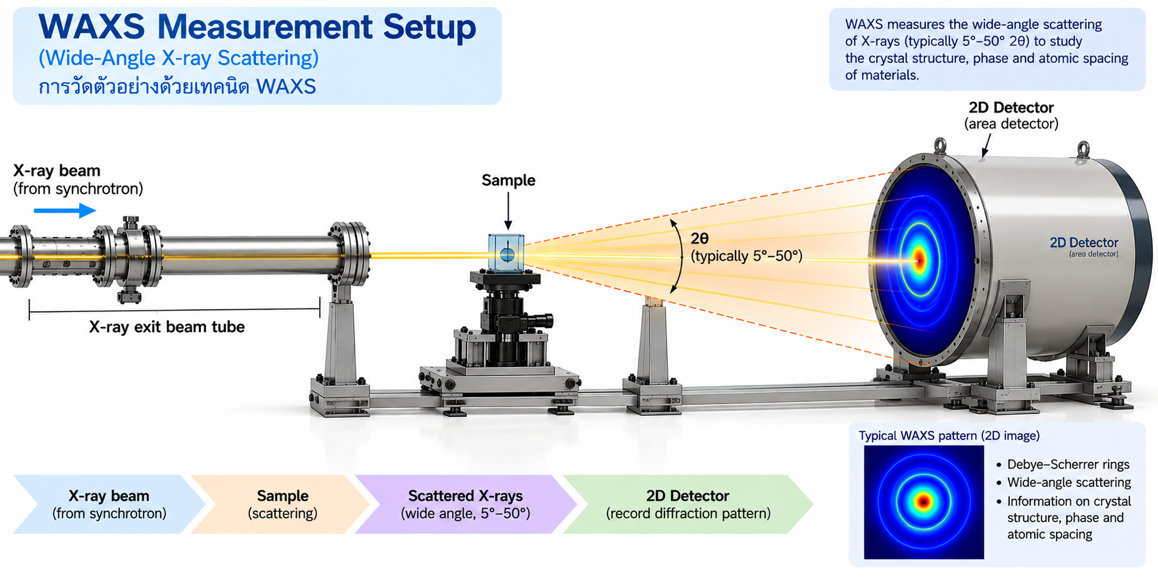
Wide-Angle X-ray Scattering (WAXS)
Wide-Angle X-ray Scattering (WAXS) is a powerful X-ray-based technique used to investigate the atomic and crystalline structure of materials. WAXS measures X-rays scattered at wide angles as they interact with the atomic arrangement within a sample.
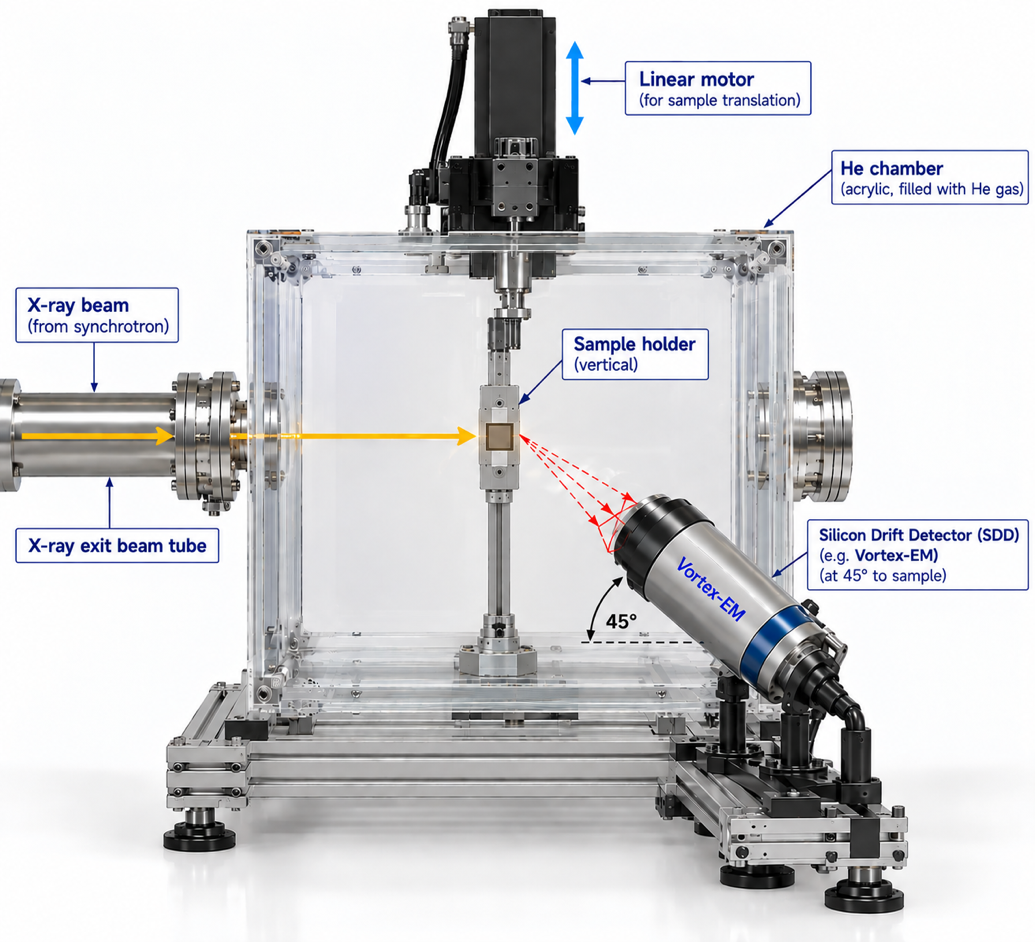
X-ray Fluorescence Spectroscopy (XRF)
X-ray Fluorescence Spectroscopy (XRF) is an analytical technique used to determine the elemental composition of a material. In XRF measurements, an incident X-ray beam excites the atoms in the sample, causing them to emit characteristic X-rays. The energy of these emitted X-rays is used to identify the elements present in the sample, while their intensity can be used for quantitative analysis. At an incident X-ray energy of 9 keV, XRF is suitable for exciting and analyzing elements whose absorption edges are below the incident energy. The selection of the incident energy is important because it affects the excitation efficiency, detection sensitivity, and background of the XRF measurement.
Detector Specifications Summary
| Detector | Technique | Specifications |
|---|---|---|
Rayonix SX165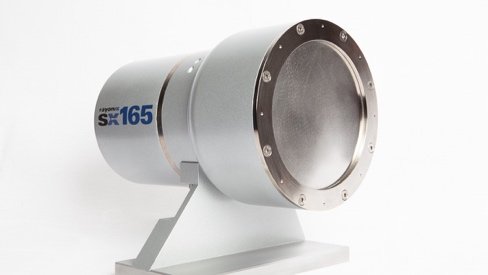 | Baseline stabilization for SAXS/WAXS | The Rayonix SX165 is a 2D X-ray CCD area detector suitable for SAXS/WAXS measurements. Key specifications include:
|
Rayonix LX170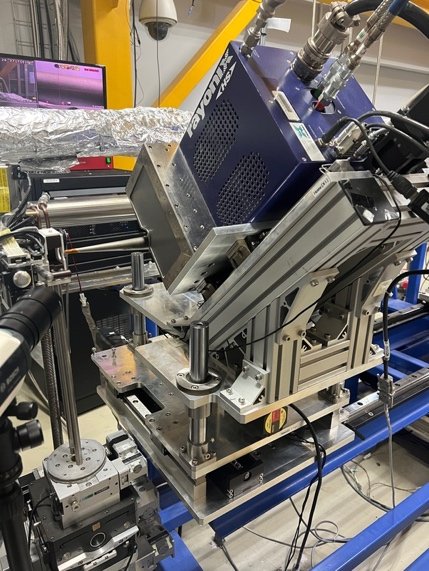 | Baseline stabilization for SAXS/WAXS | The LX170-HS is particularly suitable for simultaneous SAXS/WAXS measurements, because its long rectangular detecting surface has a notch that permits the direct X-ray beam and SAXS signal to pass through while collecting WAXS data.
|
Vortex® Silicon Drift Detector (SDD)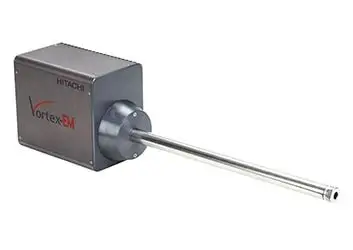 | Baseline stabilization for XRF | Single-Element Silicon Drift Detector (SDD)
|