
BL1.3W:SAXS/WAX
Small and Wide Angle X-ray Scattering (SAXS/WAXS)
Welcome to BL1.3W
BL1.3W uses synchrotron light from a Multipole Wiggler — a permanent-magnet insertion device installed in the storage ring that generates a 2.2 Tesla magnetic field, producing the intense, broad-spectrum X-rays used at this beamline. SAXS determines particle size, shape and structural organization at the nanometer scale for nanoparticles, polymers and fibers, and biological nanostructures; WAXS probes crystalline structure from polymers and biological materials to inorganic crystals; and both length scales can be measured at the same time on a single sample. XRF identifies elements whose absorption edges are below the 9 keV incident energy.
Beamline Layout & Specification

The light source is shared by three parallel beamlines — BL1.1W, BL1.2W and BL1.3W — each divided into the Front End (FE), Optics Hutch 1 (OH1), Optics Hutch 2 (OH2) and the Experimental Hutch (EH). A Double Multilayer Monochromator (W/B₄C, 150 layers at 2.5 nm per layer) selects a working energy of 9 keV (1.38 Å), tunable across 6–9 keV, and a toroidal focusing mirror focuses the beam onto the sample position. The beam travels through a vacuum tube to a beryllium window; measurements are made by opening the beam shutter and triggering the detector at the same time under computer control.
Experimental Station
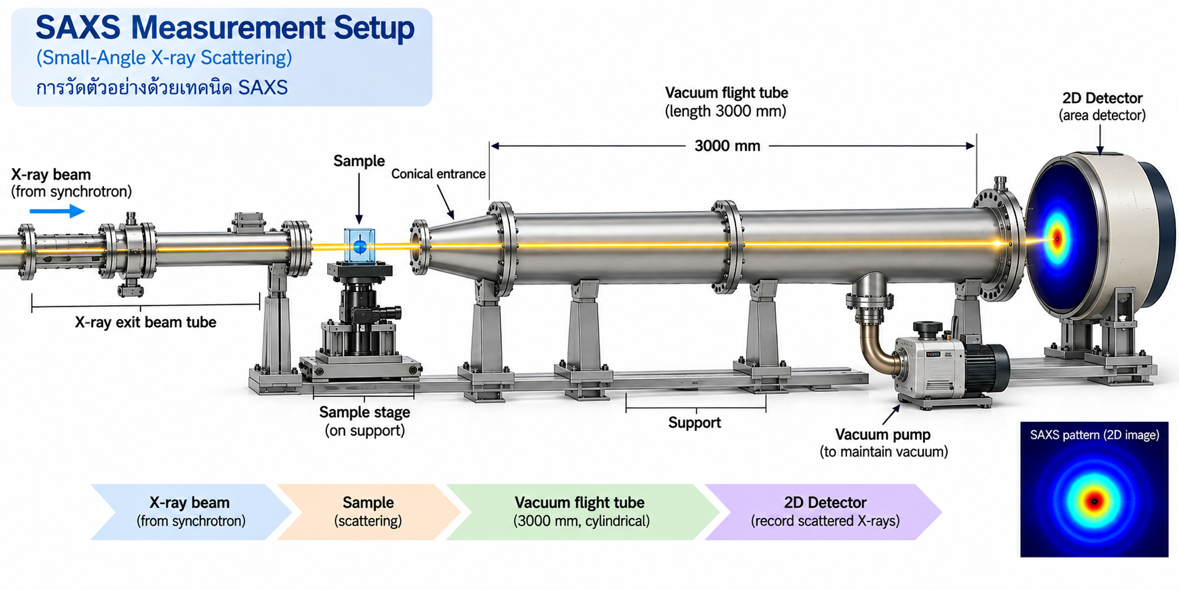
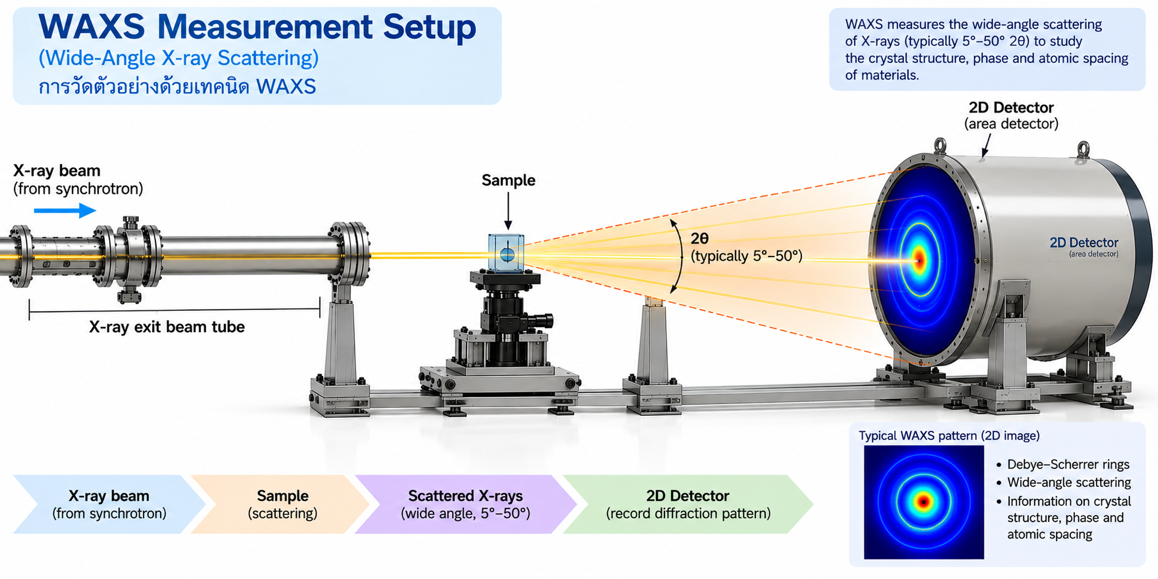
The Rayonix SX165 is a 2D CCD detector with a Ø165 mm active area, 16-bit dynamic range and DQE up to ~0.8 at 8–12 keV. The Rayonix LX170 has an 85 × 170 mm² active area with a notch that lets the direct beam and SAXS signal pass through while collecting WAXS data, making it ideal for simultaneous SAXS/WAXS (44 µm pixel at 1×1, dead time ~1 ms). For XRF, a single-element Vortex® silicon drift detector covers ~1–30 keV with Peltier cooling.
Sample Environments
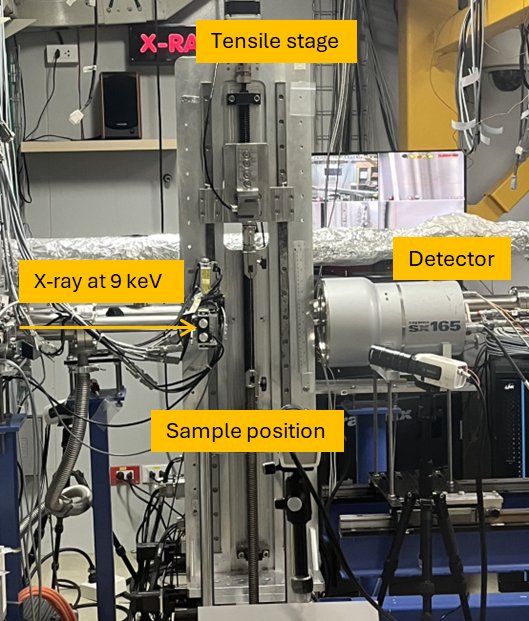
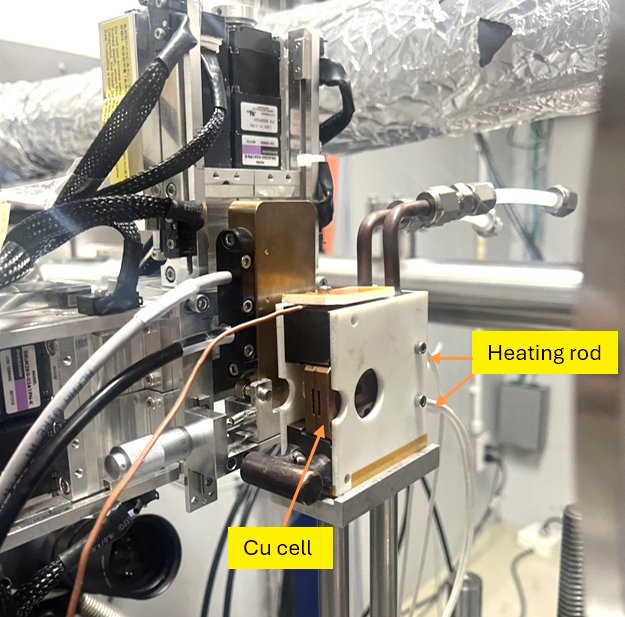
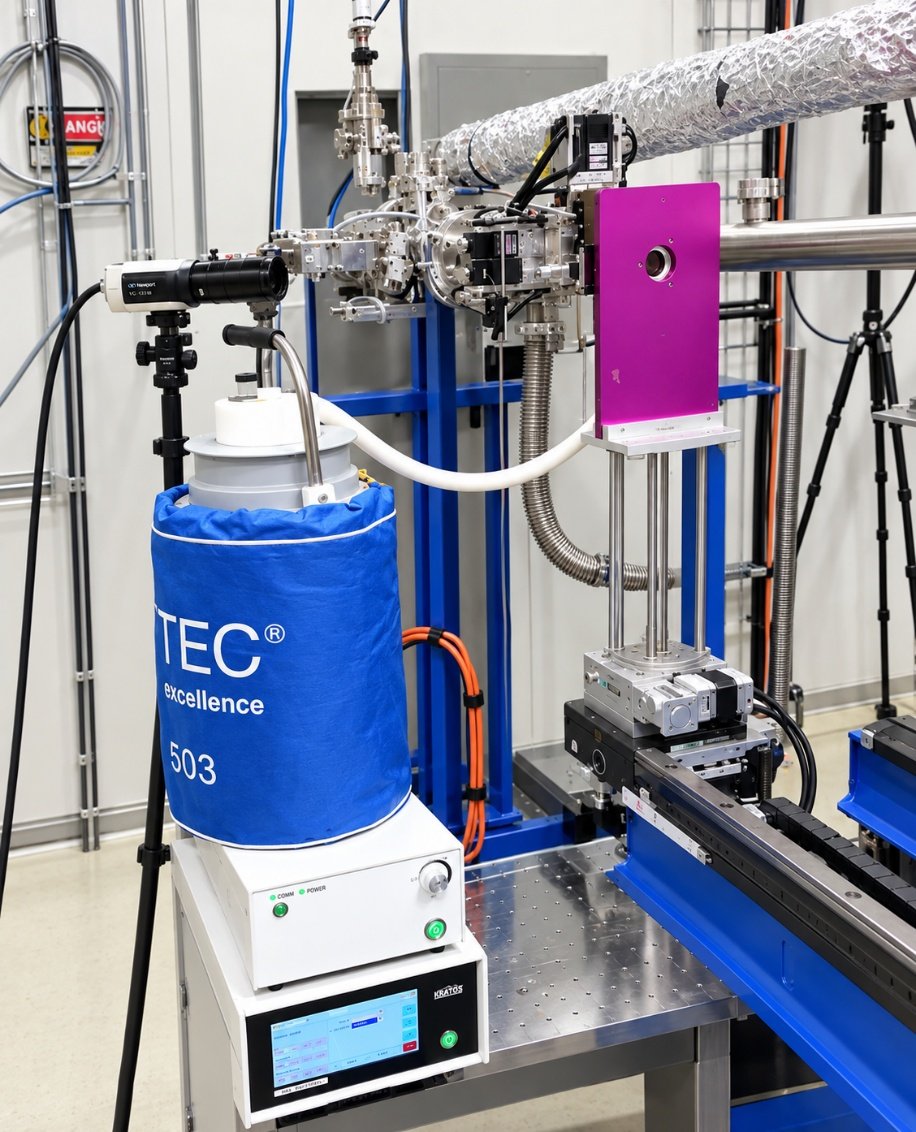
BL1.3W offers sample environments for in-situ SAXS/WAXS. Two tensile stages stretch samples with a maximum force of 500 N — the SCG stage (up to 40 cm elongation, heating to 200 °C) and the beamline stage (up to 20 cm, heating to 100 °C). A Cu heating cell controlled by a Eurotherm 2116 covers 5–200 °C with a freely programmable heating rate, while the Instec temperature-sweep system (mK2000 controller) provides precise cooling and heating from −100 to 270 °C. Automatic sample changers handle up to 34 solid or 17 liquid samples per cycle for efficient sequential measurements.